Helmholtz AI Annual Retrospective and Award Ceremony 2025
Another year has come to an end, and in December 2025 the Helmholtz AI community once again came together virtually for the Annual Retrospective and Award Ceremony to reflect on a year of remarkable progress and growth and to recognize outstanding contributions to AI-driven research across the Helmholtz Association.
A particular highlight was the continued growth of the Helmholtz AI network and its community-driven initiatives, building on the momentum of the Helmholtz AI Conference 2025, held earlier this June in Karlsruhe, which brought together researchers from across disciplines to exchange ideas and present cutting-edge AI-driven research. Attention also turned to the future, with the next Helmholtz AI Conference (HAICON26) already planned for Munich, where Helmholtz AI is hosted, further reinforcing its role as a central hub for advancing responsible and impactful AI research.
The ceremony concluded with the presentation of the Helmholtz AI Awards 2025, honoring excellence in three categories:

Best Paper
The Best Paper Award was presented to Silvia Seidlitz for the publication "AI-powered skin spectral imaging enables instant sepsis diagnosis and outcome prediction in critically ill patients" in journal Science Advances.
The awarded work demonstrates how advanced AI-driven analysis can uncover complex patterns in scientific data, contributing novel insights with broad implications for data-intensive research. By combining methodological rigor with real-world applicability, the paper exemplifies the transformative potential of AI in advancing fundamental science.
Best Digital Resource
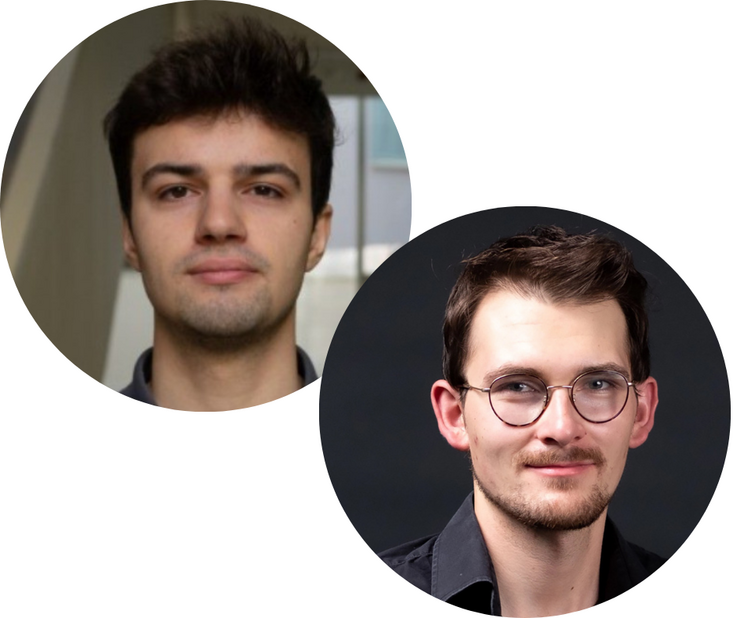
The Best Digital Resource Award went to Andrian Mirza and Kevin Maik Jablonka for ChemPile, a large-scale, multimodal dataset designed to accelerate progress in chemical AI.
ChemPile comprises over 75 billion curated tokens spanning educational materials, research literature, code, molecular representations, images, and structured chemical notations such as SMILES and SELFIES. With standardized data splits, permissive licensing, and an intuitive, machine learning–ready design, ChemPile enables robust cross-domain benchmarking while maintaining scientific rigor. By lowering barriers to training and evaluation, the resource is poised to become a foundational dataset for chemical AI research.

Best PhD Dissertation
The Best PhD Dissertation Award was awarded to Kirsten Fischer for her dissertation “Mechanics of deep neural networks beyond the Gaussian limit”.
Her work makes a significant contribution to the understanding of complex scientific systems through advanced computational and AI-based methodologies. By addressing challenging research questions with both theoretical depth and practical relevance, the dissertation exemplifies the high standard of doctoral research within the Helmholtz AI community.