Helmholtz AI Researchers @ ICLR 2026
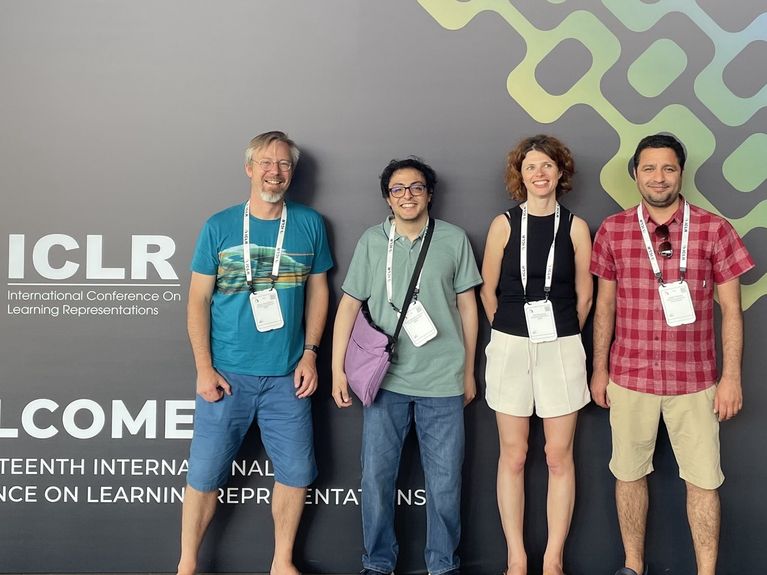
Researchers from Helmholtz AI are well represented at this year's International Conference on Learning Representations (ICLR 2026), with contributions spanning explainable machine learning, causal inference, Bayesian deep learning, neural network theory, and computational biology.
Niki Kilbertus (Kilbertus team) co-authors Identifiability Challenges in Sparse Linear Ordinary Differential Equations with Cecilia Casolo and Sören Becker, examining when causal structure can be recovered from observational time-series data, a foundational question for scientific machine learning.
The Fortuin team is represented by Amortising Inference and Meta-Learning Priors in Neural Networks, co-authored by Tommy Rochussen and Vincent Fortuin, exploring efficient Bayesian inference for neural networks.
Stefan Kesselheim (Kesselheim team) presents a poster at the main conference: Polynomial, Trigonometric, and Tropical Activations, co-authored with Ismail Khalfaoui-Hassani, which introduces new activation function families based on orthonormal bases that can successfully train large-scale models, including GPT-2 and ConvNeXt. His team also contributes When Protein Dynamics Matter: Integrating Molecular Dynamics into Protein Foundation Models to the FM4Science workshop, with Reem Aboelsoud, Javad Kasravi, and Alina Bazarova.
Zeynep Akata and the Akata team contributed three accepted papers. Alexander von Recum and Leander Girrbach, together with Akata, investigate the robustness of large reasoning models in Are Reasoning LLMs Robust to Interventions on their Chain-of-Thought? Girrbach, Stephan Alaniz (Télécom Paris), and Akata further contribute Person-Centric Annotations of LAION-400M: Auditing Bias and Its Transfer to Models, a large-scale audit of demographic bias in one of the most widely used image-text datasets, with collaborators Genevieve Smith and Trevor Darrell from UC Berkeley. A third paper, Post-hoc Probabilistic Vision-Language Models, co-authored with researchers from Aalto University, introduces a method for adding calibrated uncertainty estimates to existing vision-language models without retraining.
Fabian Theis, Scientific Director of Helmholtz AI, and members of his lab contribute multiple works in computational biology and single-cell genomics, including Structured and Interpretable Patient Embeddings from Single-Cell Foundation Models, CP-BG-1M: A Controlled Multi-View Benchmark for Density and Background Shortcuts in Morphology Profiling, Beyond Single-Axis Designs: Multi-Objective Optimization for Complex Perturbation Atlases, PerturBERT: Learning Gene Co-Variation Embeddings from Perturbation Signatures, and Learning Perturbation Effects Through Contrastive Alignment of Transcriptomics and Textual Embeddings.
ICLR 2026 took place in Rio de Janeiro, Brazil, April 23 to 27, 2026.