Multimodal Clinical Modeling, from Illinois to Bavaria: Lucy Luo’s stay at Helmholtz Munich
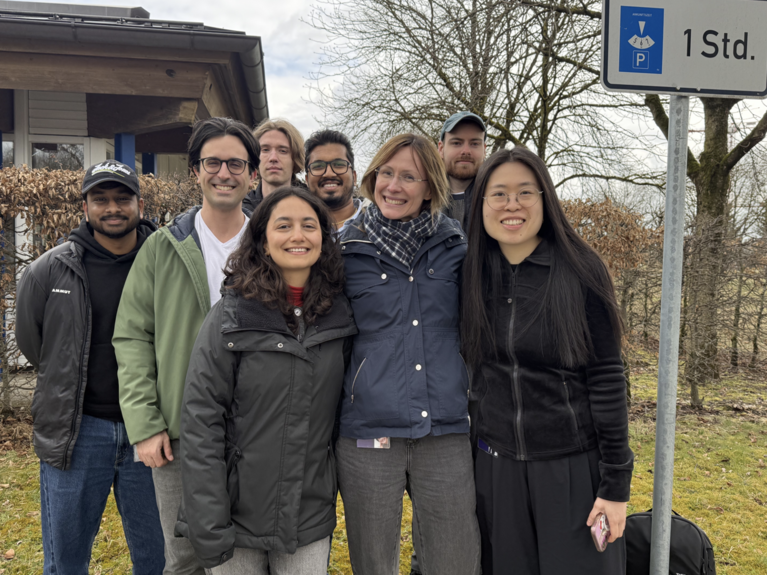
Photo credit: Dinesh Haridoss
Lucy is a MD (6th year) and PhD (4th year) student in Alexander Misharin’s lab at Northwestern University (Chicago, US). Her thesis focuses on using single cell, spatial, computational pathology, and electronic health records data to predict lung transplant outcomes. In February 2026, she joined to the Computational Health Center at Helmholtz Munich for a research stay in the group of Ewa Szczurek.
1. How did this scientific stay impact your PhD project?
Coming in, I was working on digital pathology and single-cell RNA sequencing largely as parallel workstreams. This stay gave me the space and collaborators to think more rigorously about how to fuse them. Working alongside Ewa Szczurek's group pushed me to think more carefully about the statistical modeling choices underlying multi-omics factor analysis.
2. What are the things you like the most about your stay at Helmholtz Munich?
There is so much cool computational research happening here that I can imagine many interesting ways to apply to my dataset, but also beyond this, to many other biological questions. What makes it especially generative is that people are just as eager to explore applications of their work as I am to find new uses for mine. It creates a natural current for collaboration. Also it helps to be right next to the Alps!
3. What will you take back from your scientific stay there?
Scientifically, I'm taking back a much sharper framework for how to think about multimodal modeling in the context of clinical cohorts with sparse, heterogeneous data. I’m also taking back a reminder that leaving your home institution is one of the most effective ways to see your own work from the outside.
4. How will the project you started there continue now that you have returned?
The collaboration with Ewa's group will continue remotely. We’re planning to more rigorously integrate the different data modalities in our lung transplant cohort, moving from parallel analyses toward a truly joint modeling framework. The collaboration has also opened the door to architectural refinements and methodological approaches I wouldn't have encountered without this group's expertise; that kind of knowledge transfer is exactly what a research stay should produce, and it's something I'll carry directly into the next phase of my career.
5. What would you recommend to other PhD students who want to visit Helmholtz Munich?
Come with a specific scientific question, not just a general interest. There are so many cool things going on that it's easy to get pulled in many directions. Having a concrete deliverable keeps the stay focused. Munich is a genuinely beautiful city, the parks are wonderful, and the surrounding region is all within easy reach.
Lucy's stay is a great example of the kind of international scientific exchange that strengthens AI research communities, bringing researchers across institutions and continents together around shared questions. As a Helmholtz AI Associate, Ewa Szczurek's group is part of a network where this kind of collaboration can take root and grow.