HAICON26: AI for Science Brings Together 600+ Participants in Munich
Fabian Theis, Helmholtz AI Scientific Director
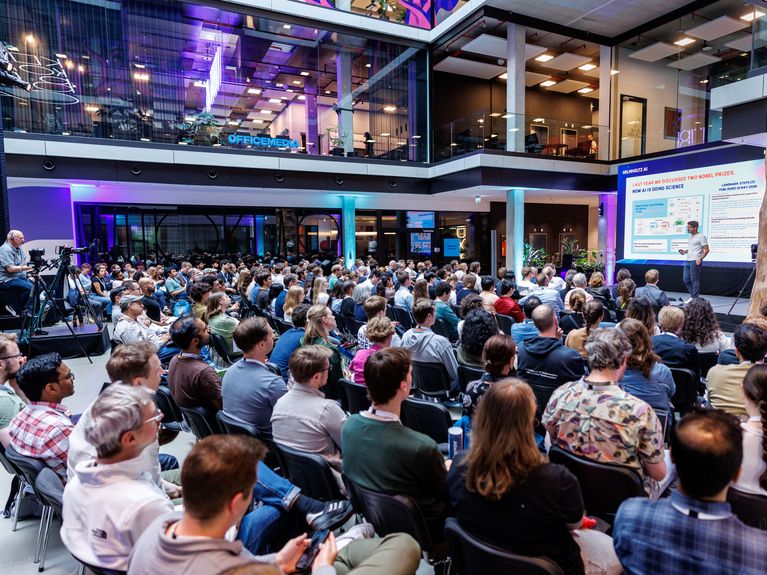
The sixth edition of the Helmholtz AI Conference, HAICON26, came to a close on 11 June 2026. Over four days in Munich — first at Helmholtz Munich Campus, then at the House of Communication — more than 600 researchers, industry partners, and representatives from 21 countries gathered under the theme “AI for Science.”
The sixth edition of the Helmholtz AI Conference, HAICON26, came to a close on 11 June 2026. Over four days in Munich — first at Helmholtz Munich Campus, then at the House of Communication — more than 600 researchers, industry partners, and representatives from 21 countries gathered under the theme “AI for Science.” It was the largest edition of the conference to date, and in more ways than one. For the first time, approximately 40% of participants came from outside the Helmholtz Association: a record that speaks to a growing community of people who see AI for science as a shared endeavour, rather than an internal, institutional one, where advancements are accelerated and achieved through exchange.

WORKSHOPS AND TUTORIALS DAY: BUILDING SKILLS AND CONNECTIONS
The conference opened on 8 June with the Workshops and Tutorials Day (WTD) at Helmholtz Munich Campus. A total of 415 participants took part in 25 hands-on sessions running across the day, covering a wide set of methods and application areas. Sessions ranged from practical deep dives, including training deep learning models across multiple GPUs, building agentic ML tools for science, and hands-on introductions to RAG and LLM systems, to more specialized topics such as medical foundation models, simulation-based inference, causal AI for complex systems in medicine and biology, quantum machine learning, and AI in environmental research. A session on GDPR-compliant AI project design and another on the science of successful AI communication rounded out a program designed to be useful to researchers at every career stage.
The day was also designed with inclusion in mind. Dedicated childcare services supported participants with families, shared breaks and lunch encouraged informal exchange, and the day concluded with a community gathering in a traditional Bavarian beer garden, bringing together participants over regional food and conversation ahead of the main conference program.
Photos WTD

Martin Hrabe de Angelis
OPENING AND SCIENTIFIC PROGRAM
The conference days opened on 9 June at the House of Communication. Fabian Theis, Scientific Director of Helmholtz AI, welcomed participants alongside Martin Hrabe de Angelis, Member and Spokesperson of the Executive Board (acting) at Helmholtz Munich. The conference was moderated throughout by Hannah Spitzer and Steffen Schneider.
Let's not take dogmas for granted!
The morning featured the AI World Café, a discussion format bringing participants together around questions that do not yet have settled answers: How should AI governance work inside research institutions? What does responsible AI look like in clinical decision-making? What happens when humans are no longer the only ones working? The format was designed for depth, and the conversations it generated set the tone for the days that followed.
World Cafe Photos
One thread ran throughout HAICON26 more than any other: AI is no longer a tool that scientists reach for selectively. It is becoming the infrastructure through which science itself is conducted, shaping how hypotheses are formed, how data is interpreted, and how discoveries are communicated. That shift was visible across the program's 17 invited speakers, 34 contributed talks, and 232 poster presentations.

Pierre Gentine (Columbia University) | KEYNOTE SPEAKER
The keynote program brought that argument into focus across the conference days. Pierre Gentine (Columbia University) opened the keynote series on 9 June with a talk titled "Lost (and found) in latent land: Applications to weather and climate," examining how latent space methods are opening new possibilities in a domain where the scale and complexity of data has long outpaced traditional approaches. On 11 June, Cordelia Schmid (Inria, Google) presented "Video-Guided Policies for Robotic Manipulation," a talk at the intersection of computer vision, reinforcement learning, and embodied AI.

Cordelia Schmid (Inria, Google) | KEYNOTE SPEAKER
Parallel sessions continued these themes across disciplines, with contributions from Moritz Hardt (Max Planck Institute for Intelligent Systems), Jilles Vreeken (CISPA Helmholtz Center for Information Security), Gitta Kutyniok (Ludwig Maximilian University of Munich), Martin Schultz (Forschungszentrum Jülich), Laura Haffert (GEOMAR Helmholtz Centre for Ocean Research Kiel), and many others, discussing foundation models, earth and climate science, imaging, and AI infrastructure.
Parallel sessions

A dedicated session titled "Helmholtz Munich: Discovering Future Health," chaired by Marie Piraud (Head of Helmholtz AI Consultants for Health), drew a direct line between AI methods and medical impact, covering AI-enabled advances in translational genomics, biophysics-informed optoacoustic imaging, predictive models of human airway function, and virtual cell modeling. Each of the four topics represented a frontier where AI is not merely supporting biomedical research but redefining what questions can be asked, and what answers are now within reach for patients.
A further highlight was "AI Research across Bavaria," co-organized with Community Partner BAIOSPHERE, which brought together perspectives from across the Bavarian AI research ecosystem. The session featured talks from Stefanie Jegelka and Daniel Rückert (Technical University of Munich), Ingo Scholtes (Julius-Maximilians-Universität Würzburg), and Annemarie Friedrich (University of Augsburg), serving as a gathering point for the broader regional scientific community.

HAICON26 also hosted its youngest speaker till now: 16-year-old Laurent H. A. Simons, one of the youngest known individuals to earn a PhD in quantum physics. Laurent presented BioXPT-Brain, a foundation model designed to decode aging and vascular dementia.

HELMHOLTZ AI PROJECT CALL 2025: ELEVEN NEW PROJECTS SELECTED
Among the most significant announcements of the conference was the reveal of the Helmholtz AI Project Call 2025 awardees on 10 June. The Project Call is Helmholtz AI's primary mechanism for funding high-risk, high-gain collaborative AI research, with 45 submitted proposals for 2025; 11 were selected.
The funded projects address scientific challenges ranging from urban air quality prediction and antimicrobial drug discovery to quantum materials simulation and precision neuroimaging. The range reflects how AI is increasingly able to address scientific problems that cross disciplinary boundaries and deliver impact well beyond individual fields.
The full list of awarded projects is available on the Helmholtz AI website here. The next Project Call opens in August 2026.
STATE RECEPTION AT THE MUNICH RESIDENZ
On the evening of 10 June, the conference moved from the House of Communication to the Munich Residenz, one of Germany's largest palace complexes and the setting for the HAICON26 State Reception, hosted by the Bavarian State Ministry of Economic Affairs, Regional Development and Energy. Researchers, speakers, and guests from across Europe gathered in its historic halls for an evening that was far from a typical conference dinner. Bavarian State Minister for Economic Affairs, Regional Development and Energy, and Deputy Minister-President of Bavaria Hubert Aiwanger and Helmholtz AI Scientific Director Fabian Theis both addressed the gathering, recognizing the work being done at the intersection of AI and scientific discovery as significant not only within research institutions, but at the level of government and public life.

POSTER PRIZE: CELEBRATING EMERGING AI RESEARCH
The conference concluded on 11 June with the announcement of the HAICON26 Poster Prize, sponsored by NTT DATA. This year, prizes were awarded across two tracks, which themselves are a small story worth telling.
The Reviewer's Choice Award followed a structured jury evaluation of submitted posters, assessed using defined criteria across three evaluation levels, designed to support consistency and reduce potential scoring biases.
The LLM's Choice Award, on the other hand, evaluated via large language models. 95 posters submitted as PDFs were reviewed by GPT-5.2, Llama, and Claude Opus 4.5, with majority voting across models determining the final rankings. The approach was exploratory by design: an attempt to understand what AI-assisted peer review can and cannot do, and where human and machine evaluations converge or diverge.
The winners:
1st Prize | NTT DATA (GPU-hour voucher valued at approximately 1,000 EUR at NTT DATA's AI Lab in Munich)
- Reviewer's Choice: Zakaria Elabid — MolecuLA: Learning Molecules As A Language For Generative And Interpretable Chemistry
- LLM's Choice: Lukas Thede — CapTrack: Multifaceted Evaluation of Forgetting in LLM Post-Training
2nd Prize | Cisco (one-day AI Workshop "Secure AI Factory")
- Reviewer's Choice: Lukas Ruff — Atlas 2: Foundation Models for Clinical Deployment
- LLM's Choice: Simon Roschmann — SOTAlign: Semi-Supervised Alignment of Unimodal Vision and Language Models via Optimal Transport
3rd Prize | Mistral AI (1-year Pro Subscription)
- Reviewer's Choice: Yannick Kees — Improving Pedestrian Detection through Temporal Movement Estimations
- LLM's Choice: Kushal Ramakrishna — Machine-Learned Interatomic Potentials for Fe–Ni Alloys: Benchmarking MACE Models for Magnetism and Phase Stability
LOOKING AHEAD
HAICON26 signalled that the AI for science community is broadening, the questions it is grappling with are deepening, and the desire for cross-institutional, cross-disciplinary exchange is growing stronger each year.
The next edition, HAICON27, will take place in Dresden from 14 to 17 June 2027. New city, new local research context, and another opportunity to take a look at where AI for science stands and where it is headed. We look forward to seeing you there!
ACKNOWLEDGMENTS
HAICON26 was made possible by the effort of many.
Thank you to the Program Chair Committee and Organizing Committee for months of dedicated work behind the scenes, and to the House of Communication and Helmholtz Munich teams for their on-site support. Thank you to our moderators Hannah Spitzer and Steffen Schneider, all session chairs, and every volunteer and student helper who kept things running smoothly.
The conference was brought to life by its contributors: our keynote speakers, our invited speakers, contributed talk and poster presenters, and the organizers of workshops, tutorials, and AI World Café sessions.
We are grateful to Community Partner BAIOSPHERE, Gold Sponsor NTT DATA, Silver Sponsor Siemens Healthineers, and our partners BioM, Clinical AI Consultants, HIFIS, Helmholtz Imaging, Helmholtz Metadata Collaboration, and HIDA. Our thanks also to the Bavarian State Ministry of Economic Affairs, Regional Development and Energy for hosting the State Reception at the Munich Residenz.