Helmholtz AI at the AI in Science Summit 2026 (AIS26)
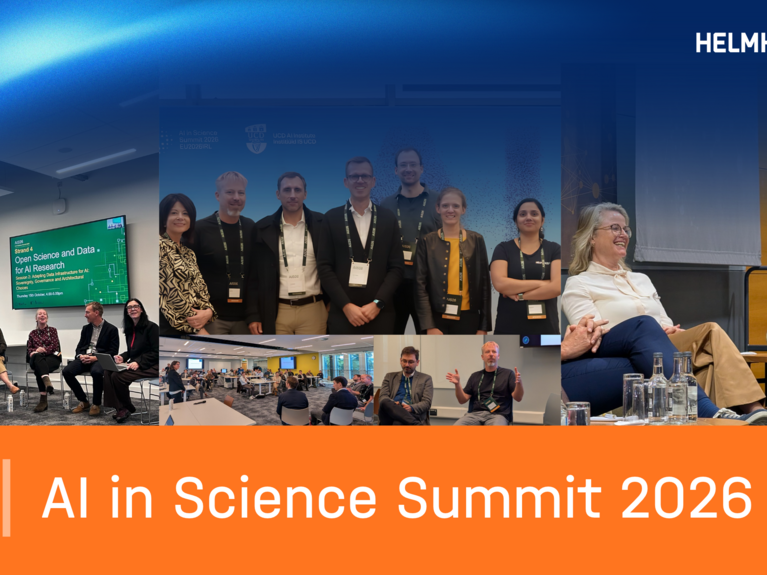
When the AI in Science Summit (AIS26) opens in Dublin on 15 October, it will turn one of the EU's central policy questions into a concrete discussion: how can Europe use AI to accelerate scientific discovery in a responsible and distinctive way? Coordinated by University College Dublin and Research Ireland as an official event of the Irish Presidency of the Council of the EU, the summit gathers researchers, policymakers, industry and investors, and puts initiatives such as RAISE, the Resource for AI Science in Europe, at its centre.
Helmholtz AI takes part in the conversation through multiple speakers and panelists: Marie Piraud, Stefan Kesselheim and Tobias Weigel - Consultancy Team Heads for Health, Information and Earth and the Environment, respectively, at Helmholtz AI. Their sessions cover One Health, foundation models for the physical sciences and AI-ready data infrastructure.

Tobias Weigel, Head of the AI Consultant Team for Earth and Environment at Helmholtz-Zentrum Hereon
DATA INFRASTRUCTURE
Tobias Weigel, Head of the AI Consultant Team for Earth and Environment at Helmholtz-Zentrum Hereon, joins the session "Adapting Data Infrastructure for AI: Sovereignty, Governance and Architectural Choices" in the strand "Open Science and Data for AI Research".
Sandra Collins, University Librarian at University College Dublin, moderates. Speakers and panelists include Gergely Sipos, Head of Services, Solution and Support at the EGI Foundation; Natalie Harrower, Executive Director of the Canadian Research Data Centre Network; and Lisa Griffith, Director of the Digital Repository of Ireland.
“FAIR is step one, AI-readiness is step two: to train trustworthy AI, Europe needs open global data – and the context that only exists where those data are created. Bringing data providers and AI researchers closer benefits both: providers see why the details they record matter, and AI researchers learn what they can expect from data and what it costs to acquire them.”

Marie Piraud, Head of the AI Consultant Team for Health at Helmholtz AI
ONE HEALTH
Marie Piraud, Head of the AI Consultant Team for Health at Helmholtz AI, Helmholtz Munich, joins the panel "How can AI enable implementation of One Health?" in the strand "AI for One Health" as a keynote speaker.
The session is chaired by Eric O'Neill, Professor of Cell and Molecular Biology at the University of Oxford. Alongside Piraud, the panel brings together Anja Schreijer, Medical Director at the Pandemic and Disaster Preparedness Center; Didier Verloo, Head of Knowledge, Innovation and Partnerships at the European Food Safety Authority; and Patty Kostkova, Professor in Digital Health and Director of the UCL IRDR Centre for Digital Public Health in Emergencies at University College London.
In her keynote, Marie showed how AI is transforming health research: it enables high-throughput experiments, helps generate new hypotheses, and makes it possible to answer questions that span multiple data modalities. The panel then turned to the opportunities and challenges of AI for One Health in particular. These include the complexity of systems that span many scales, from molecules to ecosystems, the difficulty of generalising across settings when data drift, and the infrastructure needed to bring human, animal and environmental data together.

Stefan Kesselheim, Head of the AI Consultant Team for Information at Forschungszentrum Jülich
AI IN PHYSICS AND MATHEMATICS
Stefan Kesselheim, Head of the Applied AI Lab and Consultants at Forschungszentrum Jülich, joins the panel of the session “Foundation Models for the Physical Sciences” in the strand “AI in Physics and Mathematics”.
The session is moderated by Caterina Doglioni, Professor of Particle Physics at the University of Manchester. François Lanusse, CNRS Researcher at Université CEA Paris-Saclay, and Lukas Heinrich, Professor for Data Science in Physics at the Technical University of Munich, are speakers in the session and also join the panel, together with Johannes Brandstetter, Vice-President for AI for Engineering at Mistral AI.
“Building foundation models for science isn’t just a question of scale. It’s about making the right choices about the science, the data, and the models that make the difference."
FOUNDATION MODELS
Beyond the individual sessions, the Helmholtz Association organises the workshop "Foundation Model-Driven Science in 2026: What Works and What Comes Next?" on 16 October. It builds on lessons from the Helmholtz Foundation Model Initiative (HFMI) and on a joint workshop with the European Commission held in Brussels in June 2026. The central point is that no single foundation-model approach will fit every discipline. The workshop looks at future directions: how to incorporate our models, how models can interoperate, and how the role of science agents.