“Rebuilding the city from above”: Meet Dr. Ksenia Bittner, Head of AI4BuildingModeling at DLR and Helmholtz AI Associate
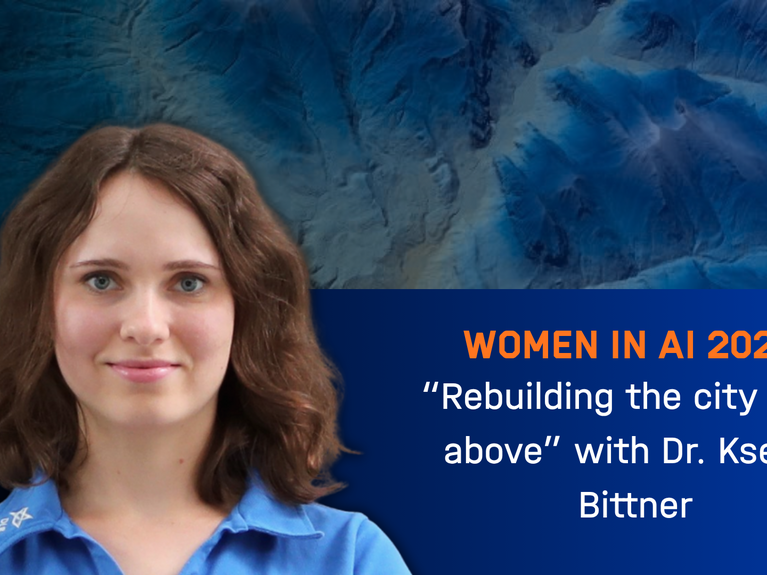
A satellite or an aircraft passes over a neighbourhood and records an image, plus a height model worked out from it; neither of them looks like a city. Ksenia Bittner's team turns them into one: separate buildings, the sections each one is made of, the roof planes on top. Her group has reconstructed an area of Cologne this way.
October is Women in AI month, and we are using it to spotlight Helmholtz AI Associates working across very different corners of research. Dr. Ksenia Bittner heads the research group AI4BuildingModeling in the Photogrammetry and Image Analysis Department of DLR's Remote Sensing Technology Institute.
The aim is output that cities can use: better OpenStreetMap and CityGML data, updated cadastral records, 3D city models built quickly rather than traced by hand. What makes that hard is the input, which almost never cooperates. This July her group published RoofVIP, a benchmark pairing roof polygons with very high-resolution orthophotos, aimed at one part of that problem. We asked her what becomes possible once a city exists as data at this level of detail, and what still does not.
- Your group turns satellite and aerial imagery into 3D models of cities, down to the shape of individual roof planes. What becomes possible once a city exists as data at that level of detail, and what is still out of reach?
Once we have a detailed 3D model of a city, we can do much more than simply visualise it. We can estimate solar potential roof by roof, analyse urban heat and energy demand, monitor how cities change, and support climate adaptation, urban planning and disaster assessment.
But getting to that level of detail is not straightforward. Our data is often incomplete or noisy: the resolution of image is too low, height models contain gaps, trees can hide entire parts of buildings, and creating perfectly matched training data with accurate labels is extremely difficult and often requires a lot of manual work.
So, imperfect data is certainly a major challenge—but I don't see it as a limitation of the field. The interesting question for us is not how to avoid imperfect data, but how to develop methods that can work with it.The rapid progress in self-supervised learning, foundation models and generative AI is giving us new ways to extract useful information even when the data is far from perfect.
We therefore approach these challenges in different ways. We develop methods that improve the resolution or the quality of spectral images, can reconstruct missing areas in height models, while synthetic data gives us perfectly controlled training examples that are difficult to obtain from real data. And for the problems like buildings partially hidden by trees or other objects, I see generative AI as particularly promising: instead of simply failing when information is missing, a model can learn to complete the partial building and infer its likely structure.
Of course, such a reconstruction is still an inference, not a direct observation. Knowing where that boundary lies—and how reliable our predictions are—is an important part of making these methods useful in practice.
-
Take us to the moment you knew this was the work you wanted to do. Where were you, and what were you looking at?
I think the moment came when I was looking for training data for deep learning to realize my goal of automatic large scale 3D building modeling maps. I was going through cadastral and 3D city data, including CityGML datasets released by public authorities, thinking that I had found exactly what I needed: existing building models that could provide labels for training.
But when I started looking closely at the data, I realised how incomplete and noisy it actually was. Buildings were missing, geometries were inconsistent, and the data was not really suitable for training large-scale AI models.
That was an important moment for me. I realised that if we want to understand and reconstruct accurately buildings at large scale, we cannot simply rely on existing maps—we have to develop methods that can deal with the imperfections of the data itself. Conventional, semi-automated approaches were not enough for that, and that became a research direction I really wanted to pursue.
-
You now lead your own research group. Was there a point where you nearly went somewhere else, in your field or in your career, and what kept you in?
There have certainly been moments when I wondered what other paths I could take, but what kept me in research was the freedom to ask questions that do not yet have answers. I really enjoy thinking about what could be done differently, testing the limits of what is possible, and then pushing those limits a little further.
What motivates me is the possibility of developing something that is not only scientifically interesting, but useful and impactful at large scale. In our field, a method can potentially be applied to entire cities or even regions, and that sense of scale is very motivating to me.
And then there is the people side of research. I enjoy meeting researchers from different countries and disciplines, exchanging ideas with people who think differently but are driven by the same curiosity. Every collaboration teaches me something new.
- A student reads that AI is competitive, male-dominated and moving too fast to catch up on. What would you say to her that is more useful than "go for it"?
I would say that the first step is not to try to catch up with everyone. AI is competitive, it can be male-dominated, and it is moving very fast—but you don't need to know everything to have something valuable to contribute.
Find your path, your niche, or an idea that genuinely interests you. Develop your own expertise around it and follow it deeply. There will always be something new to discover. Don't be afraid to ask questions, including questions that may seem simple, and don't be afraid to test crazy ideas. Some will fail, and that is part of research.
I would also say: find people who support your curiosity. A good mentor, a strong team and an international community can make a huge difference. You don't have to navigate the field alone.
And perhaps most importantly, don't wait until you feel that you are “ready.” Be curious, be brave, and start contributing. Your different perspective can be exactly what the field needs.
- Has being a Helmholtz AI Associate changed anything concrete for you: who you talk to, what you can attempt, how you work? Will we see you at HAICON27, and what are you hoping to get out of it?
Being part of Helmholtz AI has expanded the people I talk to and the ideas I can connect with. Sometimes a conversation with someone from a completely different research area can open up a new direction or a project you would not have thought of on your own. I think that is one of the real strengths of the network: together, we can move from individual ideas towards solutions with much larger impact.
And yes, I will definitely be at HAICON27. I am particularly looking forward to the discussions and new connections. I hope to come away with new research directions and, ideally, new collaborations with other Helmholtz institutions.