Helmholtz AI Conference 2026: a World Café Wrap
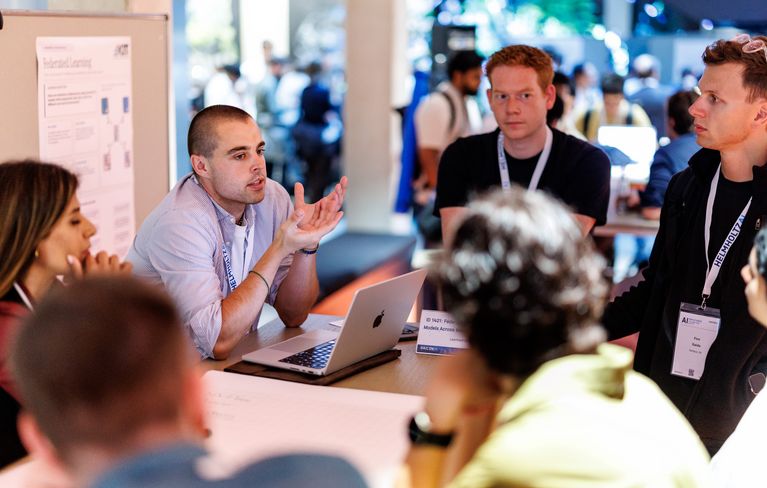
On June 9, 2026, the Helmholtz AI Conference hosted the AI World Café – a 90-minute session that brought together researchers and professionals from diverse backgrounds, creating a strong platform for open dialogue and collaborative exchange.
Similarly to last year, participants formed small groups of up to 10 and rotated through three 20-minute rounds of vibrant discussions, covering both predefined and spontaneous AI-related topics. We would like to share our insights with you - enjoy our World Café report below!
-

Introduction
Coming from science management and sitting between researchers, administration, IT, and leadership we wanted to explore a tension that we see every day: new tools arrive faster than policies, training often does not reach the right people, and nobody is quite sure who owns AI governance.
Key ideas
We started by asking three open questions:
- How to regulate without over-restricting?
- How can we build skills across very different roles?
- Who is actually responsible for what?
Key outcomes
People don't want more rules but better mechanisms: enhanced review (also by putting humans in the loop), critical reflection, and the question of whether mandatory courses are the right lever at all. The table seems to have agreed that an ad-hoc/unmanaged approach is unsustainable, but that heavy-handed top-down regulation risks similar outcomes.
Skills transfer & enablement was the most discussed topic. Participants named basic AI literacy as a foundation, then immediately complicated it: "How can we build skills?" leads to "scalability of training" and the gap between one-off workshops and something that actually sticks. Participants reported a high diversity between live training vs. recorded/online formats, and between using external/internal resources. Student feedback was flagged as a key input. The overall impression: training needs to be modular, scalable, and draw on what already exists within and beyond an institution.
The question "Who is actually responsible?" led to a key diagnosis: fragmentation of responsibilities. Proposed responses included a dedicated institutional AI office, ethics specialists, and the library as an existing trusted infrastructure that could take on an AI role. Living documents over static policies, weekly AI updates as a lightweight continuous mechanism, and role models as a cultural lever rather than a structural one.
The underlying tension: institutions want someone to own this, but in some instances nobody has the mandate and/or capacity to do so yet.
Further discussion
Looking ahead, institutions need to do more than just define who’s responsible. They have to build the real-world structures and cultural habits that make AI stewardship work over time. That means creating spaces where people across departments can actually collaborate, where decisions are made openly, and where learning about AI is an ongoing part of the job, not a one-time checkbox.
-
Motivation:
Large-scale particle accelerators such as DESY produce extremely bright X-ray beams that enable high-resolution imaging and analysis of both biological and material systems, deepening our understanding of physical and living matter. However, the detectors and experimental setups used in these systems typically provide incomplete, noisy, or intensity-only measurements. This limitation naturally leads to the development of computational methods designed to solve inverse problems, ranging from classical optimization techniques to modern deep learning approaches.
In phase-contrast imaging, the full reconstruction pipeline consists of a sequence of interconnected ill-posed inverse problems: (i) flat-field correction,
(ii) denoising without removing fine physical structures, (iii) phase and absorption retrieval from propagated intensity measurements, (iv) tomographic reconstruction, and (v) segmentation. Each stage introduces its own assumptions, instability, and potential sources of error, which propagate through the pipeline.
This raises a central question: can these steps be unified into a single framework that solves all sub-problems by simply changing the underlying physics, i.e., the forward operator, while keeping a shared reconstruction principle? In this context, we explore unified self-supervised frameworks that operate without the need for ground-truth training data. The goal is to understand both the opportunities and challenges of such approaches, and to investigate how they can be accelerated, stabilized, and deployed across different imaging modalities.
What are Inverse Problems?
Inverse problems are a central class of problems in applied mathematics in which unknown parameters of a system are inferred from observed, often noisy, measurements. Their difficulty depends on properties such as stability, uniqueness, and existence of solutions, which are rarely guaranteed in practical settings.
Advances in optimization methods, regularization theory, Bayesian inference, and more recently deep learning, have significantly improved our ability to solve inverse problems across disciplines.
These problems arise in a wide range of fields. In our discussion, participants highlighted applications including medical imaging in neuroscience and cancer research, micro- and nano-scale imaging, ptychography, materials science and photovoltaic design, particle and astrophysics, electrical circuit analysis, super-resolution in satellite imaging, and denoising tasks in general imaging systems.
Self-supervised methods for solving inverse problems:
In inverse problems, progress rarely appears as a sudden invention. It unfolds as a sequence of ideas that gradually tightens the link between data, physics, and learning.
The story begins with a simple tension: many imaging problems are ill-posed. In X-ray holography, for example, only intensity is measured, while the quantities of interest—phase and absorption—are hidden. Early approaches relied on careful preprocessing, such as flat-field correction and denoising, to stabilize the data. Yet even after these steps, the core problem remained: reconstructing a complex field from incomplete measurements.
At the same time, deep learning began to reshape how priors could be expressed. Instead of requiring large labeled datasets, methods like Deep Image Prior (https://dmitryulyanov.github.io/deep_image_prior) showed that the structure of a neural network itself could act as a prior. In parallel, self- supervised and physics-informed approaches () emerged, shifting the focus away from ground-truth supervision and toward consistency with known physical laws.
A natural convergence of these ideas appears in phase retrieval. Here, the forward process is well understood; light propagation follows Fresnel diffraction. This physical model becomes the backbone of reconstruction. A neural network can be used to predict phase and attenuation directly from a hologram, while enforcing constraints such as non-positive phase and non-negative absorption. The predicted fields are then propagated forward through the Fresnel operator to reconstruct the measured intensity. Learning is driven entirely by the mismatch between reconstructed and observed measurements.
What makes this formulation powerful is that it closes the loop between learning and physics. The model does not need labeled ground truth; it only needs the measurement process itself. Despite the ill-posed nature of the problem, this self-consistency is sufficient for convergence to physically meaningful solutions.
This shift also changes how inverse problems are approached more broadly. Instead of requiring large curated datasets, single-shot reconstruction becomes possible. In structured settings such as tomography, where multiple observations share underlying geometry, learning can transfer across measurements efficiently. Architectures like U-Nets further contribute by implicitly favoring smooth, denoised reconstructions, while techniques like early stopping prevent overfitting to noise.
Across these developments, a consistent narrative emerges that inverse problems are no longer solved by separating data, models, and physics. Instead, they are solved by coupling them directly into a self-consistent learning system where physics defines the constraint, and learning provides the flexibility.
Generalizability of solvers:
Once a model has been built to solve phase retrieval, the immediate question is what happens if the same framework is applied elsewhere. The surprising result is that many inverse problems share the same underlying structure: an unknown signal is transformed by a known or partially known forward operator and observed through noise or compression. This means a model designed for phase retrieval can often be adapted to tasks such as flat-field correction, denoising, deconvolution, deblurring, tomography, and even segmentation. The core change is not the model itself, but the physics or mathematical operator it is paired with, along with the priors that encode domain knowledge.
This perspective shifts the problem from designing task-specific solvers to designing adaptive inverse frameworks. Instead of building a new network for every problem, one can construct a reusable backbone that learns how to invert structured operators. Each application then becomes a variation of the same theme: the same learning machinery, but different forward models and constraints. This opens the possibility of a more universal inverse problem solving paradigm—not a single model that solves everything, but a flexible system that can be reconfigured across domains.
The Future of Universal Inverse Problem Solvers:
This idea is already reflected in modern computational frameworks such as DeepInverse ( deepinv.org). It provides a modular environment where different forward operators can be defined and combined with learned reconstruction methods. The key contribution of such frameworks is not only performance but structure: they formalize inverse problems as interchangeable components, encouraging a shared ecosystem of operators, priors, and solvers.
At a broader level, this connects directly to how data complements physics. In many real-world settings, the forward model is incomplete or unknown. We may not have a mathematical definition for complex semantic structures such as “cat” or “tumor,” yet data-driven learning allows us to approximate these mappings through examples. In this sense, data fills the gap where physics ends. This is the same principle underlying foundation models, which aim to capture broad, transferable representations across tasks and domains. They do not replace physics but extend it into regimes where explicit models are unavailable or incomplete.
Together, these developments point toward a unified view: inverse problems are no longer isolated tasks, but instances of a shared structure. The future lies in systems that can adapt across problems by swapping the forward operators and priors, while retaining a common learning core that connects data and physics.
One thing pointed out in our discussion was having a dictionary for inverse problems that we currently face at Helmholtz. I say, why not?!
-
Our World-Cafe discussed the challenges of developing and certifying AI systems for safety-critical applications. A central question was how to determine when an AI system is “safe enough” and who should be responsible for making that decision.
Participants agreed that domain experts are best positioned to assess acceptable safety levels through empirical testing, while regulators and other stakeholders must address legal and ethical aspects. However, many of these stakeholders lack a deep understanding of AI systems. Therefore, AI engineers must be able to explain model behavior, uncertainties, and limitations transparently and understandably.
A key topic was the importance of explainability, uncertainty estimation, and high-quality, bias-free data. Participants emphasized that evidence of data quality and model performance is essential to support certification. Existing standards can provide guidance, but they struggle to keep pace with modern AI developments and are often formulated in quite general terms.
The discussion further highlighted that established engineering practices, such as requirements-driven engineering and classical verification and validation (V&V), remain highly relevant for AI systems. Since extensive real-world testing is often costly, future approaches may use foundation models to generate edge cases and test scenarios. Especially the combination with neurosymbolic methods can help to ensure physically valid and trustworthy outputs.
The main conclusion was that certifying an AI system requires more than validating a final model. The entire AI engineering pipeline, including development processes, data, and design decisions, must be considered. Future work should focus on methods that more effectively connect AI engineering practices to safety and certification requirements.
-
The discussion brought together educators, researchers, and practitioners to explore how generative AI is transforming educational resource creation, delivery, and adaptation.
Participants shared their current uses of AI in teaching, which primarily include structuring lectures, drafting scripts and teaching materials, creating visualizations, and identifying jargon or unclear explanations to improve accessibility and clarity.
A broad consensus emerged that students should be allowed to use Large Language Models (LLMs) as part of their learning process, provided they receive a foundational “LLM 101” education covering also the limitations, and responsible use of these tools. The Helmholtz AI Consultant Team is already contributing to this effort through dedicated training. Participants also emphasized that the timing of AI adoption is critical: while AI can accelerate concept acquisition, skill development still requires time, practice, and productive struggle. As one participant noted, “Would we give a calculator to a child who is still learning basic arithmetic?”
Another recurring theme was the need for greater adaptation and personalization in education. Creating personalized learning experiences at scale requires significant effort, and participants saw strong potential for AI-powered assistants or agents that could tailor explanations, exercises, and learning pathways to individual learners' needs.
The challenge of designing robust assessments in the age of AI was also discussed extensively. Participants agreed that current assessment approaches are increasingly under pressure, but no clear consensus emerged regarding effective solutions for AI-resilient or AI-integrated assessment.
A further insight was that many educators, particularly in higher education and research environments, have received little formal training in pedagogy. Participants highlighted the importance of supporting educators in applying established teaching and learning principles when developing AI-assisted educational materials. Rather than simply prompting AI to “create content on topic X,” educators could be encouraged to incorporate pedagogical objectives and learning theories into their prompts, for example including retrieval practice, scaffolding, worked examples, and constructive alignment.
This discussion led to the idea of developing a practical booklet or guide for educators, containing example prompts and workflows for common educational tasks such as audience adaptation, exercise generation, accessibility improvements, and pedagogically informed content creation.
Finally, participants agreed that a centralized catalogue of educational resources and courses across Helmholtz would facilitate sharing, reuse, and collaboration among educators. As a next step, they suggested working with HIDA to include a contact person for each course of the Data Science Course Portfolio, making it easier to connect and exchange experiences.
To continue this work, an interest group will develop a practical booklet for educators and explore an AI assistant for creating pedagogically sound, personalized learning materials. The group aims to present its progress and initial outcomes at the next TEACH6 conference.
If you are interested in joining this interest group or contributing to these activities, please contact us at donatella.cea@helmholtz-munich.de , mueller3@hzdr.de, s.starke@hzdr.de , j.goshi@hzdr.de .
-
Our discussion began with a simple but important question: Can AI help make cities not only smarter, but also healthier, cleaner, and more pleasant places to live? While urban AI is often associated with efficiency, automation, and smart infrastructure, we wanted to explore how these technologies can directly improve people's everyday lives and contribute to more habitable cities.
A significant part of the conversation focused on air pollution, which many participants identified as one of the most visible environmental challenges in urban areas. The group discussed how AI can help us better understand pollution patterns by combining data from air-quality sensors, weather observations, traffic systems, and satellite measurements. Participants agreed that AI has great potential not only for monitoring pollution but also for predicting high-risk situations and supporting more informed environmental decisions.
One of the most interesting points of discussion was the balance between technological capability and human trust. While everyone recognized the value of advanced AI models, there was broad agreement that transparency and explainability are essential. Participants emphasized that urban AI systems should help people understand why decisions are being made, rather than functioning as black boxes. In this sense, AI should support human decision-making rather than replace it.
Several promising ideas emerged during the discussion. These included the use of urban digital twins, explainable AI, and integrated environmental intelligence systems that can provide real-time insights into urban conditions. Participants also highlighted the importance of linking environmental information with public health outcomes, enabling cities to take preventive actions rather than simply reacting to problems after they occur.
Looking ahead, the discussion revealed strong interest in further collaboration across disciplines, including AI, environmental science, urban planning, and public health. A key takeaway was that the future of urban AI should be human-centered. Success should not be measured solely by technological advancement, but by whether AI helps create cleaner air, healthier communities, and more sustainable urban environments. Ultimately, participants agreed that the goal is not simply to build smarter cities, but to build cities that are better places for people to live.
-
Motivation: Fast code, hidden errors
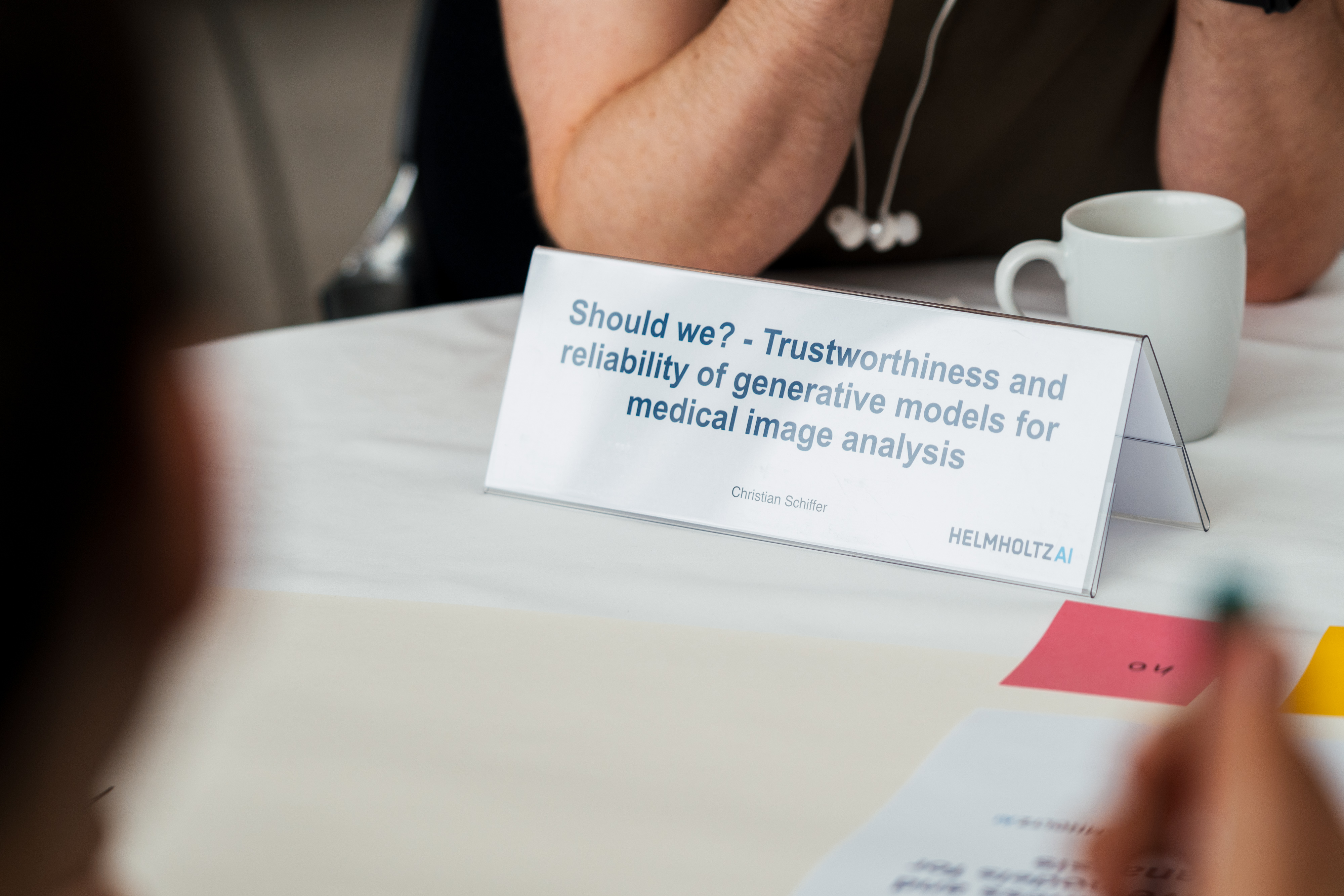
Generative AI writes syntax faster than any of us, but it optimizes for code that compiles rather than code that is fundamentally true. Pointed at a hard, domain-specific problem, an unguided model will sometimes hallucinate a rule or scientific law, or silently discard an established principle just to keep the code working. The output can look entirely convincing while being fundamentally invalid, a failure that is easy to miss precisely because nothing breaks. The table brought together people from a wide range of disciplines to ask how scientists can use these tools without letting them quietly overwrite hard-won domain expertise. The answer the room kept arriving at was a clear division of labor and boundary: the scientist stays in charge of the logic, and the AI is held to the syntax. Most of the discussion was about why that line is needed and how to hold it.
Discussion: Logic, syntax, and the line between
Much of the conversation began with concrete failures, and they were similar from one field to the next. The example that recurred most was an AI or LLM deleting working functionality in the middle of an edit, overwriting code that had already been validated, or ignoring fundamental scientific principles (e.g., energy conservation). People also described the slow accumulation of "AI slop," where a project keeps adding to the code until it grows past the point where the model can track its own structure, or it keeps creating numerous libraries and files. The unclear licensing of generated code came up as a separate, more practical worry. Across all examples, the common feature was how nothing looked wrong from the outside while quietly failing: the code compiled and ran, and the mistake stayed hidden until someone went looking for it.
From these failures the discussion moved, round after round, toward the same conclusion. The trouble starts when there is no clear division of labor, and the remedy is to keep the scientist firmly in charge of the scientific logic and boundaries of the project, while restricting the AI to implementation and optimization. The researcher dictates the concepts and constraints, ultimately defining what correct behavior looks like through their domain expertise. The model then writes the corresponding syntax. The agreement was close to unanimous across the disciplines at the table, and most participants turned out to already work in a similar way without having an explicit name for it.
On guardrails, the table had more open questions than settled answers, with standardized tests, scalability, maintenance, and review time all raised as ongoing problems. The practices that came up were modest but useful: committing frequently and keeping track of the prompts that generated working code, such that there is always a route back when the model removes something; fixing random seeds so that genuine errors can be separated from ordinary statistical variation; reviewing changes one feature at a time; separating the scientific logic into different files so that an unrelated change cannot silently corrupt it; and carrying these habits forward as work moves into agentic coding with multi-file setups.
Running under the whole conversation was a sense that the scientist's job is changing, moving from writing code toward reviewing it. The optimistic reading is that the work simply moves up a level, from producing syntax to overseeing concepts. The harder question, which this discussion did not settle, is whether that oversight still holds once it is the only thing you practice. It works only as long as you have the expertise to identify a silent error, and that expertise may be exactly what fades when the AI writes everything. That worry came up only briefly, though. What people kept returning to was how much these generative tools now make possible, including the freedom to sandbox speculative ideas that were never worth the coding time before.
Follow-up potential: from instinct to tested practice
The convergence was the part worth following up. A table with scientists from a wide range of disciplines still arrived at the same boundary between logic and syntax, and named the same failure modes, while working on completely different problems. A focused follow-up could test which guardrails are universal and which ones actually hold up in each field, and turn an instinct that clearly travels across disciplines into practice that has been checked against real cases.
-
The discussion focused on whether healthcare AI should move beyond predicting patient outcomes and instead support individualized treatment decisions. Central to the debate was the proposed iPITE (integrated Predicted Individual Treatment Effects) framework, which combines clinical evidence, molecular data, and Bayesian decision theory to estimate patient-specific treatment responses under uncertainty.
What was most controversial, or about what did all participants agree on?
There was broad agreement that AI should not replace existing clinical decision-making processes. Participants emphasized that AI systems must demonstrate clinical value beyond predictive accuracy and should support, rather than substitute, clinician judgment. Explainability and interpretability were considered essential prerequisites for adoption, since clinicians need to understand the reasoning behind treatment recommendations.
The most controversial topic concerned the definition of a “good” treatment decision and who should ultimately determine it. Participants discussed the challenges of integrating AI recommendations with clinician expertise, patient preferences, and clinical context. Questions of trust, legal accountability, and professional responsibility generated the most disagreement.
What were the key ideas?
A central idea was that prediction and decision-making are not the same. Participants argued that a model can accurately predict outcomes while still producing poor treatment recommendations. Therefore, healthcare AI should be evaluated not only by predictive performance but also by the quality of the treatment decisions it enables.
Another important theme was the role of molecular data. Genomic, transcriptomic, and epigenomic information should not merely serve as additional predictors but should be incorporated as fundamental components of model design, particularly for diseases with strong biological drivers.
The discussion also highlighted the importance of uncertainty. Rather than reducing uncertainty to a single prediction, AI systems should propagate uncertainty through the decision-making process and communicate confidence levels to clinicians. This would allow treatment recommendations to better reflect the limitations of available data.
Finally, participants addressed the challenge of validation. There was strong agreement that predictive accuracy alone is insufficient to assess clinical usefulness. While randomized controlled trials remain the ideal validation strategy, alternative approaches such as simulation studies, emulator-based validation, and external cohort testing may provide valuable evidence before deployment in clinical settings.
Do you see any follow-up on this discussion?
No specific follow-up activities or future actions were proposed during the session. However, participants acknowledged that several challenges remain unresolved, particularly regarding trustworthy validation, uncertainty-aware decision support, and the long-term integration of AI-assisted recommendations into clinical practice.
-
Introduction
To effectively use ML/DL models, the instructions on how to perform inference and set up the required compute environment need to be clear. However, models developed by scientists often lack clear documentation. Furthermore, comparing different models on the same problem can be time-consuming, as each model requires its own setup procedures.
Discussion
We discussed approaches how to make ML/DL models developed by researchers easier to use. The experience of the attendees showed that bad usability is widespread across fields. While this especially affects less technical users, everyone struggles with models that are difficult to deploy. One suggestion was to change the incentives in academia to provide better installation instructions together with your published model, such as guidelines from the scientific institutions or requirements from the publishers.
While unified access to models is still difficult, there are several steps that can simplify usage of models. Creators of new models can upload the weights to Hugging Face to easily share them and follow good software engineering practices to help with dependency management (e.g., use an environment.yaml file or provide conda or container environments).
Conclusion
The problem is widespread and affects many users. While a comprehensive solution requires actions from the broader scientific community, there are small changes everyone can make to improve the accessibility of their models.
-
Introduction
The discussion at the World Café focused on identifying what stages of the AI/ML lifecycle participants encounter, what tools they are using, what is missing, and what is problematic. We also tried to look at the lifecycle from a researcher and industry perspective.
Key results
In the discussion, participants shared their insights on the AI/ML lifecycle and agreed on the main stages, named the tools they use or know of, and also the stages that take the most effort. This was summarized in the form of the following table:
Stages Tools Problematic Planning / Literature research Standard LLMs,
(AI Consultant)^2Data acquisition Manual, public repos (e.g. HuggingFace (HF)) Data exploration LandingAI (PDFs)(paid), MinerU Data preparation LabelStudio, BATS, CVAT Data preparation and formats Model prototype Environment: local machine, VMs Training experiments (pytorch) Profiler, coding agents Tuning of models Evaluation Weights&Biases, NeuroMiner, MLFlow, Tensorboard Documentation / Sharing Manubot (https://manubot.org (?)), HuggingFace, Helmholtz ModelZoo Deployment Azure, GCloud, AWS, K8s@Research Institute Hardware constraints for inference Monitoring Grafana, MLflow, Ydata Data drift The listed tools can be either general and applicable in various scientific domains or more field-specific, like BATS or NeuroMiner. Some tools are developed or provided within Helmholtz, e.g., (AI Consultant)^2 , BATS, Helmholtz ModelZoo, MLflow (pilot at mlflow.scc.kit.edu ), to name a few; others come from external communities or as (paid) cloud services.
In the discussion, it appeared that people in academia tend to stop at the Documentation/Model sharing stage, e.g., by achieving a publication in a journal/conference/model zoo, while for industry, it is important to deploy a production service with corresponding monitoring. There was a brief discussion on automation of the AI/ML lifecycle, where the MLOps paper from Google and the MLOps overview from KIT were mentioned.
A possible follow up
A valuable follow-up would be to maintain a curated overview of tools and possible solutions for the problematic stages, and also capturing the perspectives and needs of different roles: domain researchers, data scientists, engineers, platform developers, … The Matrix room for the followup discussions: https://matrix.to/#/#mlops:kit.edu
-
Federated learning (FL) was discussed as a way to fine‑tune large AI models collaboratively across institutions while keeping sensitive data strictly local to each site.
At the table, participants raised concerns about model reconstruction attacks and data leakage, debating how effective homomorphic encryption, differential privacy, added noise, and secure aggregation are in protecting patients while still delivering useful models. There was broad agreement that FL itself is not automatically GDPR‑compliant; robust privacy‑enhancing techniques and careful governance are needed on top of the basic protocol.
Concrete use cases came mainly from healthcare, as they see FL as a way to pool knowledge about rare diseases across hospitals without centralizing data, provided that data alignment and harmonization are done beforehand. Existing projects already use frameworks like FeatureCloud, Sage, or NVFlare and experiment with personalized model updates per client to balance global generalization with local adaptation.
Looking ahead, the group highlighted open questions around bias and non‑IID data, aggregation of different foundation models across sites, and evaluation when ground truth is distributed. The biggest hurdle to still overcome is to convince people to really apply it and to somehow “trust” it.
Subscribe to our newsletter
Stay up to date with all things AI in science across the Helmholtz Association.
Subscribe