Vincent Fortuin wins ERC Starting Grant
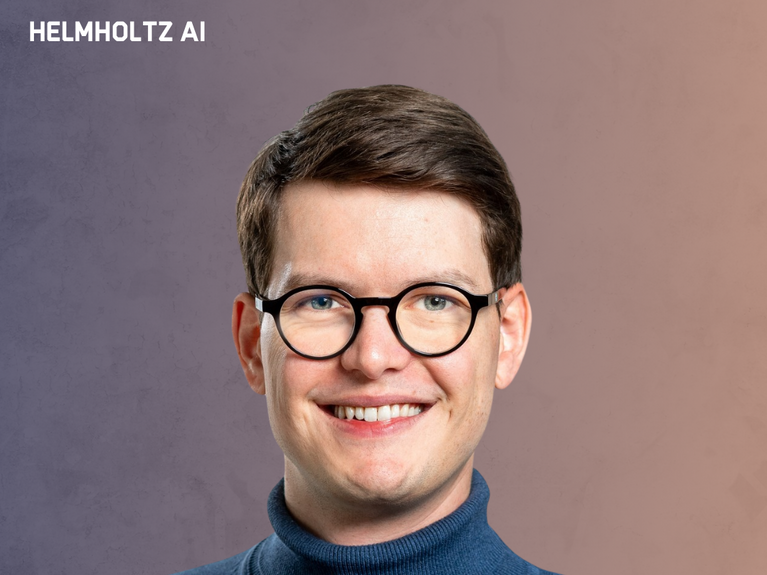
Vincent Fortuin, a Principal Investigator at Helmholtz AI, has won an ERC Starting Grant. His project, AutoBayes, focuses on making deep learning more reliable when training data is scarce.
Vincent Fortuin leads the ELPIS lab (Efficient Learning and Probabilistic Inference for Science) at Helmholtz AI. In January 2026, he was appointed Full Professor of Probabilistic Machine Learning at the University of Technology Nuremberg (UTN), where the ERC grant is now hosted.
His work applies Bayesian statistics to deep learning. Standard deep learning models often need large amounts of training data and can be overconfident in their predictions. His approach targets both problems. This matters for scientific applications in particular, where data is frequently limited and reliable uncertainty estimates are essential. The AutoBayes project, titled "Unlocking Reliable Small-data AI through Bayesian Deep Learning," will develop new methods in this direction over the next five years.
Before joining UTN, Vincent Fortuin held positions at ETH Zurich, where he completed his PhD, the University of Cambridge, and the Technical University of Munich. He is a Branco Weiss Fellow, an ELLIS Scholar, and a Fellow of the Konrad Zuse School of Excellence in Reliable AI. He also serves on the board of the Probabilistic Machine Learning conference and the ISBA section for Bayesian AI.
The ERC Starting Grant is one of the European Union's most competitive funding instruments for early-career researchers. In this year's round, the ERC awarded 421 grants worth a total of €705 million, selected from 4,807 applications. Grants in this scheme typically provide up to €1.5 million over five years, supporting researchers as they build independent teams and pursue ambitious research programs. For more information, see the most recent ERC press release.
We congratulate Vincent on this achievement and look forward to seeing what AutoBayes uncovers!
Learn more about Vincent Fortuin’s work:
-
Shaping the Future of AI: How Dr. Vincent Fortuin and Colleagues Are Making AI Safer and More Reliable

-
A planet's whole life story, not just a single snapshot: Asynchronous Bayesian optimization is helping astronomers see past a longstanding retrieval problem

-
Interview with Dr. Vincent Fortuin on reliable AI

-
Helmholtz AI Researchers @ ICML 2026

-
Helmholtz AI Researchers @ ICLR 2026
